
The UK’s international capital story is broader than FDI alone – and financial and related professional services is an important part of the story
The UK’s ability to attract international capital is a major economic strength, supporting investment, market depth and the wider contribution of financial and related professional services. The UK is one of the world's leading destinations for foreign direct investment (FDI). According to UNCTAD data, the UK was the world’s 6th-largest recipient of inward FDI in 2025.[1]
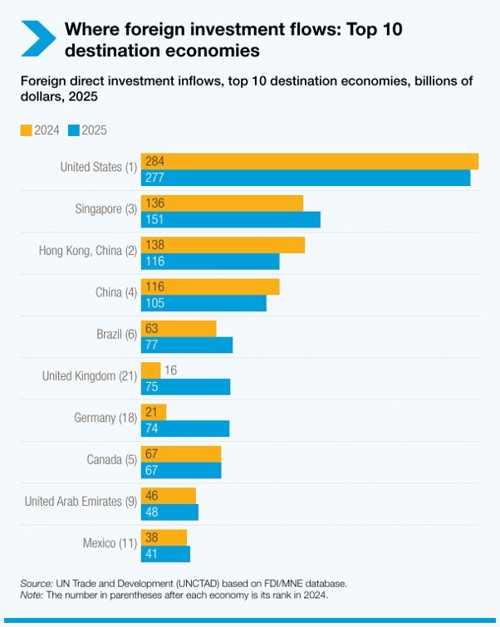
Although the vast majority of inward investment into the UK is from the US and Europe, major economies in other parts of the world also feature prominently. India, for example, is an important source of investment, and the UK’s stable regulatory environment makes it an attractive destination for investments from Sovereign Wealth Funds, many of which are from the Middle East.[2]
FDI is a volatile indicator…
The UK’s 6th-place position in 2025 was a notable change from 2024, when it ranked 21st in terms of inward FDI flows. This highlights how volatile an indicator FDI can be. This is also in evidence when we consider specifically financial and related professional services investment, which is an important part of the UK’s overall FDI story. Foreign firms employ hundreds of thousands of people across the UK and play a substantial role in the sector’s overall economic contribution. To take just one example, S&P Global invested £4m in a new office in Manchester in late 2025. International firms also reinforce London's position as one of the world’s leading international financial centres.
In 2024 (latest available annual data), the UK financial services sector recorded negative inward FDI flows of £21.4bn, representing net disinvestment. In contrast, the professional, scientific and technical services sector – which includes the legal, accounting and management consulting firms that comprise TheCityUK’s ‘related professional services’ – attracted £4.5bn in inward FDI. Because of the extent to which FDI data can change from year to year, taking a longer-term view is important. Between 2021 and 2024, the professional, scientific and technical services sector attracted £39.1bn in cumulative FDI inflows, making it the UK's third-largest recipient sector and accounting for around 30% of total FDI inflows during that period. In contrast, financial services recorded cumulative net disinvestment of £17.6bn. These data are presented in the latest edition of our ‘Key Facts about UK-based financial and related professional services’ research.
Cumulative inward FDI flow by top sector, £bn, 2021-2024*
Source: Office for National Statistics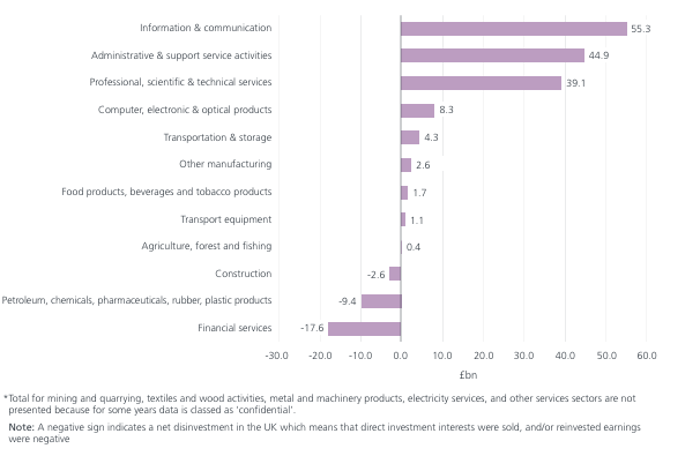
Net disinvestment in the UK means that FDI outflows exceeded inflows – in other words, sales of direct investment interests exceeded new investments, and/or reinvested earnings were negative. Although this can sometimes indicate lack of investor confidence in an economy, it can also result from normal business operations – for example, if a multinational firm sells a subsidiary as part of a corporate restructuring. More context would be needed to evaluate whether the negative number is indeed ‘negative’ in a qualitative sense.
…and it only tells part of a country’s investment story
Another important contextual piece is that FDI is just one aspect of foreign investment, and maintaining a narrow focus risks overlooking the broader ecosystem of international capital on which the UK's financial and related professional services industry – and indeed its wider economy – depends.
Foreign portfolio investment (FPI) receives much less attention among policymakers and the public than FDI does, perhaps because data are harder to come by and because news headlines tend to focus on large acquisitions, particularly in manufacturing and industry since investment in services firms can be harder to visualise. But this is an oversight, especially since the stock of FPI in the UK is much larger than the stock of FDI, as explained by new research from Barclays:
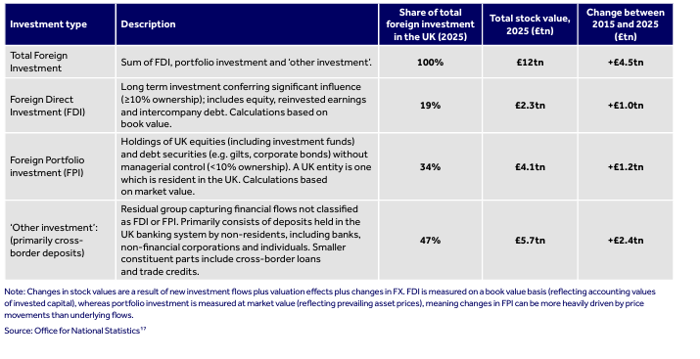 Barclays’ report offers a valuable broadening of the analysis, noting that FDI accounts for only around 20% of the more than £12trn of foreign capital invested in the UK. The remainder consists of cross-border deposits (almost 50% of the total) as well as FPI. Barclays describes cross-border deposits as “cash deposits held in the UK by non-residents…[including by] banks, cash holdings by multinational corporations (MNCs) – used either for their UK operations or wider corporate treasury purposes – as well as deposits from non-resident individuals.” They noted that over half of total UK banking system deposits are foreign deposits; this reinforces TheCityUK’s finding that the UK is one of the world’s largest centres for cross-border banking, and that this characteristic reinforces the UK’s standing as a leading international financial centre.[3]
Foreign investment is especially important given fiscal constraints
There are valid reasons that FDI, FPI and cross-border deposits are traditionally considered separately from a statistical perspective, but Barclays makes a valuable contribution by “treating [them] as parts of a single foreign capital ecosystem.” That broader ecosystem is important not only as a pillar of the UK’s international financial centre role; it also matters because the UK needs substantial pools of international capital to finance both private-sector activity and public spending. Foreign investors hold substantial stakes in UK equities, thereby funding companies; and in gilts, thereby supporting government borrowing. Indeed, foreign holdings of gilts have increased steadily over the past decade, so that around one third of total gilt holdings were by non-residents in 2025. Less than six weeks before the first budget presented by the new Labour administration, the observation that fiscal constraints make foreign investment an important source of financing feels incredibly timely.
[1] UNCTAD, ‘World Investment Report 2026’, available at: https://unctad.org/publication/world-investment-report-2026-international-investment-turbulent-era
[2] For more detail on SWF investment into the UK, see TheCityUK, ‘Sovereign Wealth Funds: Global trends and the UK’s role in the evolving landscape for Sovereign Investment Vehicles’, (November 2024), available at: https://www.thecityuk.com/media/2lkb5g5y/sovereign-wealth-funds-global-trends-and-the-uk-s-role-in-the-evolving-landscape-for-sovereign-investment-vehicles.pdf
[3] For more detail, see TheCityUK, ‘Key facts about the UK as an international financial centre 2025’ (January 2026), p.9, available at: https://www.thecityuk.com/media/woaizj2o/key-facts-about-the-uk-as-an-international-financial-centre-2025.pdf
