
How do Britain’s financial and related professional services exports stack up against other exports?
In my last blog post, I used OECD data to explore patterns in the UK’s financial services trade over the past 20 years, finding that such trade remains deeply anchored in the UK’s traditional ‘corridors’ with its largest Advanced Economy partners.
Meanwhile, our latest Economic Research report looks at financial and related professional services trade from the other side, so to speak. It considers sources rather than destinations, examining where exports originate within Britain (Britain rather than the UK, because we couldn’t include Northern Ireland). We quantified financial and related professional services exports from the 11 British regions and nations, finding that around half of industry exports originate, in the aggregate, in areas outside London.
The report opens by placing these findings in context, asking a more fundamental question: how important are financial and related professional services exports within Britain’s overall export landscape? The answer is that far from being niche exports, financial and related professional services are absolutely central to the UK’s export performance in terms of both scale and growth.
One of the clearest demonstrations of this is the weight of these exports within total services trade. Financial and related professional services account for almost 40% of wider services exports, reinforcing the UK’s position as a global leader in high-value, knowledge-intensive trade. They accounted for more than 20% of total (goods plus services) exports in 2023.
The data also show that financial and related professional services are not just large—they are also a key driver of export growth. Total services exports reached £465bn in 2023, up 14% from 2022. Within this, financial and related professional services exports from Britain reached £174.3bn, up 9% year on year. This means that the industry was responsible for almost one quarter of the growth of total services exports. This is particularly important given the wider context: goods exports declined by 3.6% over the same period.
Over the past few years, global trade has taken place in an unusually turbulent environment, buffeted by supply chain disruptions, Russia’s invasion of Ukraine, other rising geopolitical tensions, and increased protectionism. Goods trade has been particularly exposed; services trade has been more insulated, since many internationally traded services are less directly dependent on physical supply chains, and are not directly impacted by policy changes like the imposition of tariffs. This has helped services exports remain comparatively resilient, providing an important source of economic support for countries like the UK with highly competitive services sectors.
Our analysis shows that this relative resilience is widely spread throughout Britain as well: services exports outweigh goods exports in four out of the 11 regions and nations, making up more than half of total exports in London, the South East, Scotland, and Yorkshire & the Humber. In the East of England, the split is about 50-50.
Total exports by region and nation, 2023
Source: Office for National Statistics and TheCityUK calculations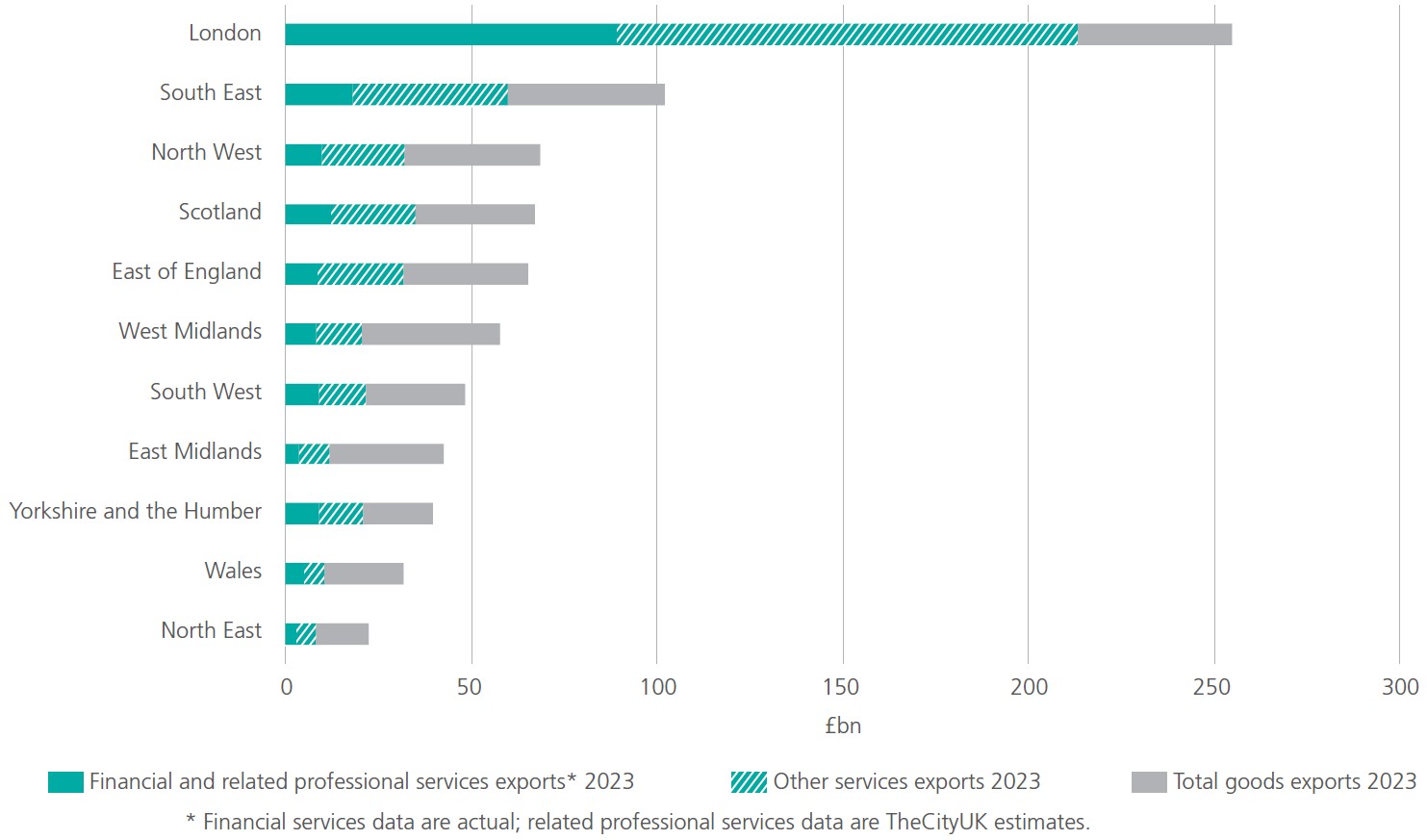
The data in our report extends only to 2023, because official trade statistics are published with a long lag. This means that the most recent global and economic trade shocks are not captured in our published data – but they are unlikely to have altered the overall trajectory of British financial and related professional services exports because of the factors mentioned above.
Looking ahead, the global context makes these findings even more salient. Ongoing geopolitical tensions – most recently in the Middle East – have yet again exposed the vulnerability of global goods supply chains, particularly in energy and other commodities. This in turn is likely to have a negative impact on economic growth across a swathe of countries, including the UK. Against that backdrop, the UK’s ability to generate export earnings from services provides a degree of economic support and resilience that is too often underappreciated.

