
A rule-based approach reveals where financial services trade is genuinely emerging. We map shifts in global financial services trade to identify the markets that could offer new opportunities for the UK.
We recently published ‘Global financial services trade in transition’, a short paper using the same OECD dataset that I used in this blog post exploring the UK’s financial services trade relationships with the US and the EU. Our recent paper reiterated a point made throughout our body of economic research: the UK’s financial services exports are heavily concentrated in advanced economies. The EU and the US together account for around two thirds of sector exports and also two thirds of the UK’s 168% growth in financial services exports in the 20 years to 2024.
Building on the analysis featured in the earlier blog post, our recent paper also examined the gradual diversification - both realised and potential - of this trade. To do this, we brought some analytical rigour to the assumption that long-term shifts in global trade patterns have created emerging trade corridors in which regions that host fast-growing emerging and developing markets trade more with one another. We asked, if such emerging corridors exist (in contrast to established corridors like the UK-US corridor), what actually characterises them, and how many are there?
To answer these questions, we used a rule-based classification so that our analysis was strictly objective. We defined emerging corridors by combining metrics representing low initial trade values, sustained high growth, and minimum cumulative trade. Put simply, this approach helps us avoid two common traps. Looking only at growth rates can make very small and potentially volatile trade flows seem more important than they are, while looking only at size favours corridors that are already well established.
This analysis found that only 18 corridors out of 153 examined were classed as ‘emerging’, demonstrating that global financial services trade continues to be anchored by large, well-established corridors linking advanced economies.
Number of inter-regional corridors by category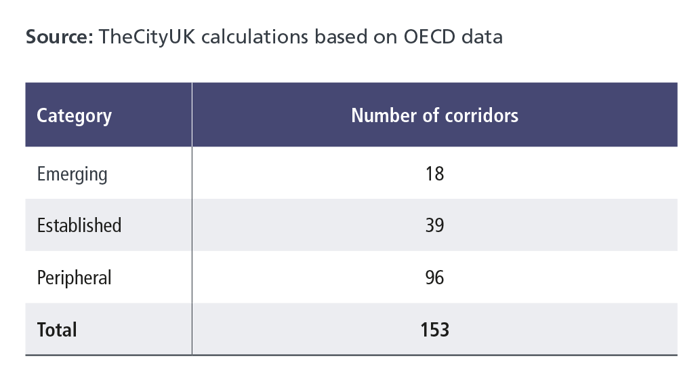 Economically significant new trade relationships remain rare. This observation is represented visually in the chart below:
Inter-regional financial services trade corridors: Global distribution
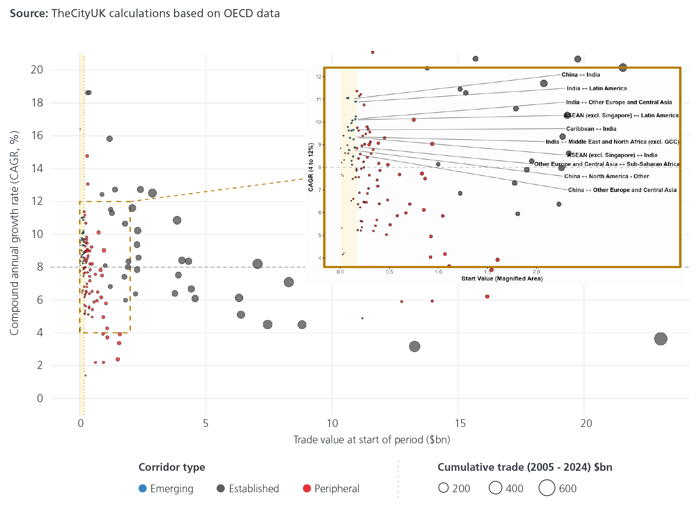
We excluded the two largest established corridors, EU-US and North America (Other) - US,[1] from the chart to enhance the visualisation. The chart demonstrates the interaction of the three criteria established in the analytical framework by showing each corridor as a bubble. We have deliberately not labelled most bubbles, because the chart’s intention is to emphasise dispersion, position and categorisation of the bubbles, not to identify specific corridors.
Considering our three metrics, the chart uses the horizontal axis to show the initial trade base and the vertical axis to show the long-run growth of financial services trade within a given corridor. Thus, a corridor placed in the upper right of the chart demonstrates both a high significant starting trade values - which would preclude it from being classed as ‘emerging’ - and a high rate of trade growth. Cumulative total trade is represented by the size of each bubble. Based on these three criteria, the bubble colour reflects whether the corridor has been classified as peripheral, emerging or established.
Almost all the corridors are clustered to the far left of the chart, highlighting visually that initial financial services trade values are very small in all except a handful of corridors. Within this cluster, many of the bubbles appear nearly identical in size and spatial positioning, yet carry different classifications (for example, emerging versus peripheral).
To make this more visible, we have enlarged this part of the chart in the inset. Emerging corridors satisfy all three thresholds simultaneously: a low starting base, high growth, and a minimum cumulative trade volume. India-Latin America (labelled in the chart inset) is one example.
While numerous corridors meet one or two of these conditions, they are classified as peripheral if they fail to fulfil the third condition as well. For example, India - Singapore shows rapid growth and meets the threshold of meaningful cumulative scale, but the starting value of financial services trade within that corridor was above the bottom quartile of the distribution of initial inter-regional trade values.
Many of the emerging corridors are connected to Asia and other regions home to numerous fast-growing emerging and developing economies. This type of objective, detailed analysis therefore helps us understand how trade corridors are realigning, and how the UK might potentially service trade corridors beyond those involving Europe and the US. Strategies to target emerging corridors more effectively can help drive future commercial opportunities, but such strategies need to be tailored to the particular geographies, and the first step is therefore to determine, using consistent, rule-based criteria, what the relevant geographies are.
[1] For details of country groupings, see the Appendix of the ‘Global financial services trade in transition report’, available at: https://www.thecityuk.com/our-work/changing-landscape-for-global-financial-services-trade/
